NA
North America
Canada · USA · México
Seventeen pieces and three countries: Celtic fiddle on Canada's Atlantic coast, Appalachian porches, the Mississippi Delta, New Orleans brass and the sones of Mexico.
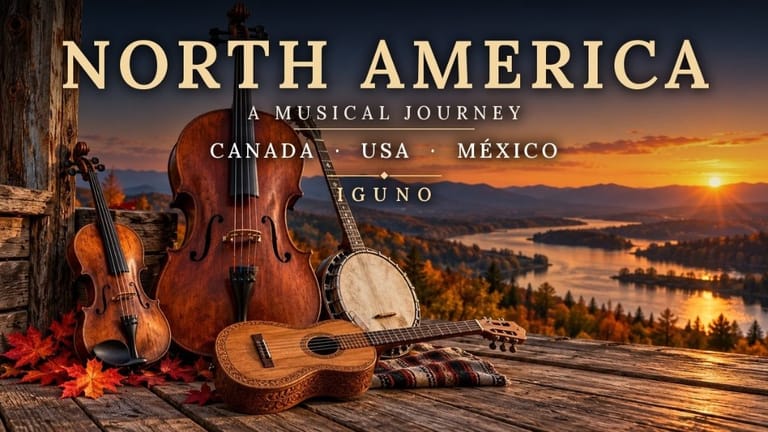
Traditions
- Cape Breton fiddling in Nova Scotia preserves Scottish Gaelic repertoire and bowing that shifted or faded in Scotland itself.
- Quebec's reels are played with the feet: the seated player taps a rhythm — podorythmie — while bowing, and the crooked tunes add or drop beats where the dance asks.
- Appalachian string band music carries Scots-Irish tunes reshaped by the banjo, an instrument of West African descent.
- The Mississippi Delta gave the blues its twelve-bar frame and its bent, between-the-notes pitch.
- New Orleans brass bands come from the city's parade and funeral tradition, where the second line follows the band.
- Mexican son is regional rather than national: son jarocho on the Veracruz coast, son huasteco in the northeast, mariachi's son jalisciense in the west.
Instruments
- Fiddle — Cape Breton, Quebec and Appalachian, each with its own bowing
- Five-string banjo — of West African descent, central to Appalachian music
- Harmonica and slide guitar — the voice of the Delta blues
- Brass — trumpet, trombone and sousaphone of the New Orleans parade
- Jarana and requinto — the small guitars of son jarocho
- Vihuela and guitarrón — the rhythm and bass of mariachi
Music from here
The story
The written story for this journey is still being set down. The music, the traditions and the instruments above are complete.